The Definitive Guide to Skincare Toner OEM: How to Build a Bestselling Brand
Table of ContentsUnderstanding Skincare Toner OEM vs. ODM vs. Private LabelMarket-Driven Toner Formulations to ConsiderThe Step-by-Step OEM Manufacturing Workflow1. R&D...
Table of Contents
- Understanding Skincare Toner OEM vs. ODM vs. Private Label
- Market-Driven Toner Formulations to Consider
- The Step-by-Step OEM Manufacturing Workflow
- 1. R&D and Sample Conception
- 2. Stability and Compatibility Testing
- 3. Regulatory Compliance Auditing
- 4. High-Speed Mass Production and Filling
- Evaluating Your Skincare Toner OEM Partner
- Certifications and Cleanroom Standards
- Minimum Order Quantities (MOQs) vs. Scalability
- Packaging Sourcing Integration
- Managing the Total Investment Cost
Partnering with a professional cosmetics OEM allows you to bypass the massive capital requirements of manufacturing facility construction, chemical sourcing, and regulatory laboratory management. This guide explores the strategic advantages of skincare toner OEM processing, breaks down trending formulations, and outlines how to select the right manufacturing partner to scale your business.
Understanding Skincare Toner OEM vs. ODM vs. Private Label
Navigating the terminology of contract cosmetics manufacturing is essential before signing procurement agreements. While these terms are frequently grouped together, they offer varying levels of customization and intellectual property ownership:
- Skincare Toner OEM (Original Equipment Manufacturer): Under a pure OEM model, the brand provides the exact formulation specifications, branding assets, and packaging designs. The manufacturer functions strictly as the production factory, blending ingredients, filling bottles, and packaging final units to your precise blueprint.
- Toner ODM (Original Design Manufacturer): The manufacturer handles both the formulation research and development (R&D) and production. They pitch pre-made, high-performing formulas to you, and you add your logo, brand aesthetics, and custom packaging.
- Private Label: The fastest turnaround option. You select a ready-made, stock toner formulation directly from the manufacturer’s catalog and house it in standard stock packaging with your custom labels affixed.
Choosing a customized OEM approach gives your brand absolute control over ingredient quality, texture profile, and unique selling propositions (USPs), setting your products apart in a crowded digital marketplace.
Market-Driven Toner Formulations to Consider
Modern consumers are highly educated on cosmetic ingredients. To build authority and satisfy search engine and AI-driven product recommendation algorithms, your OEM toner must feature functional, scientifically backed active ingredients.
The table below outlines the three major toner categories driving global sales and the key ingredients required for each:
| Toner Category | Primary Target Benefit | Key OEM Ingredients to Specify | Ideal Skin Type |
| Hydrating & Barrier Repair | Replenishes deep moisture, calms redness, restores lipid layer | Hyaluronic Acid, Ceramides, Centella Asiatica (Cica), Panthenol (Vitamin B5) | Dry, Sensitive, Dehydrated |
| Exfoliating & Brightening | Unclogs pores, refines skin texture, fades hyperpigmentation | Salicylic Acid (BHA), Glycolic/Lactic Acid (AHA), Niacinamide, Vitamin C | Oily, Acne-Prone, Dull |
| Soothing & Microbiome Care | Balances skin pH, supports natural skin flora | Bifida Ferment Lysate, Galactomyces, Rose Water, Green Tea Extract | All Skin Types, Mature Skin |
The Step-by-Step OEM Manufacturing Workflow
Launching a custom skincare line requires structured collaboration with your manufacturing partner. A typical B2B skincare toner OEM pipeline spans several clear phases:
1. R&D and Sample Conception
Your brand submits a product brief detailing the target market, desired viscosity (water-like vs. essence-like), specific hero ingredients, and exclusions (e.g., alcohol-free, fragrance-free, vegan). The OEM factory’s laboratory chemists prepare initial bench samples for your evaluation.
2. Stability and Compatibility Testing
Once you approve the initial sensory properties of the sample, the formula undergoes rigorous stability testing. It is exposed to varying temperature fluctuations and UV light cycles over a period of 4 to 12 weeks to ensure it will not separate, change color, or lose chemical potency on retail shelves. Concurrently, compatibility tests ensure the liquid toner does not degrade or leach components from your selected packaging material.
3. Regulatory Compliance Auditing
To distribute your products legally, the formulation must pass safety assessment protocols relevant to your target markets. This includes FDA compliance for the United States, CPNP registration for the European Union, or NMPA filing for mainland China. A reputable OEM partner provides documentation assistance, including Certificate of Analysis (COA), Safety Data Sheets (SDS), and Good Manufacturing Practices (GMP) certifications.
4. High-Speed Mass Production and Filling
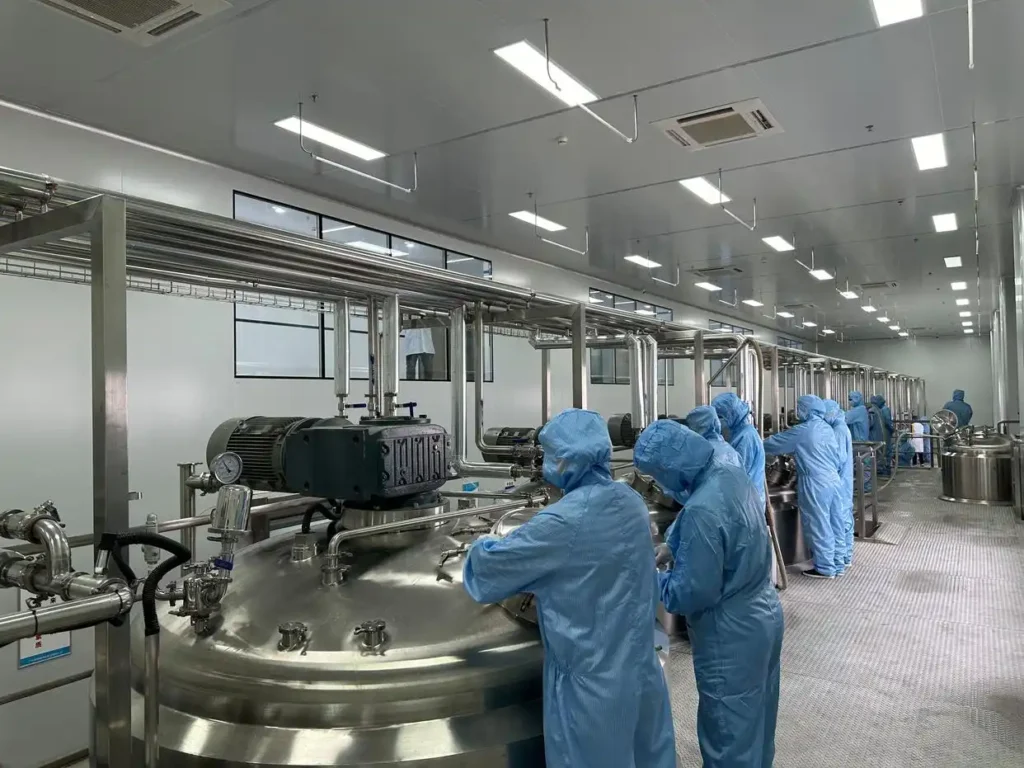
Following regulatory sign-off, raw ingredients are blended in large-capacity industrial mixing vats. Automated filling machinery dispenses the toner into sterilized containers, applies safety seals, seals the caps, and executes automated boxing and shrink-wrapping.
Evaluating Your Skincare Toner OEM Partner
Selecting a manufacturing facility is a long-term strategic decision. Poor quality control or supply chain delays can damage your brand’s reputation. Evaluate potential partners against the following operational criteria:
Certifications and Cleanroom Standards
Ensure the factory operates under ISO 22716 (Cosmetics — Good Manufacturing Practices) and GMPC standards. The mixing and filling areas should feature controlled air filtration systems (Class 100,000 cleanrooms or higher) to completely eliminate airborne microbial contamination risks.
Minimum Order Quantities (MOQs) vs. Scalability
For emerging brands, initial cash flow is vital. Look for an OEM partner that balances reasonable entry-level MOQs (typically 3,000 to 5,000 units for custom formulations) with the industrial infrastructure needed to scale production up to 50,000+ units per run as your demand grows.
Packaging Sourcing Integration
A comprehensive OEM provider offers turnkey supply chain integration. They should either manufacture packaging options in-house or maintain vetted, strategic partnerships with bottle and pump suppliers. This prevents logistical issues where production delays occur because your formulation is ready but your custom glass or PET bottles are stuck at a separate printing facility.
Managing the Total Investment Cost
When calculating the budget for your skincare toner OEM project, factor in the complete scope of production costs beyond the liquid bulk price per liter:
- Formulation R&D Fees: Custom lab adjustments outside standard stock bases.
- Tooling and Molding Costs: Required if you design an exclusive, custom-shaped bottle instead of selecting standard industry packaging components.
- Third-Party Lab Validation: Mandatory microbial challenge testing, dermatological patch testing, and heavy metal screening.
- Shipping and Freight Logistics: Moving finished pallets from the OEM factory floor to your fulfillment center or Amazon FBA warehouse.
By developing a clear understanding of these manufacturing realities, aligning your ingredient choices with modern clean-beauty consumer trends, and choosing a certified, transparent OEM facility, you can efficiently build a high-margin skincare brand with sustainable market growth.